Showing posts with label WWII surfing. Show all posts

Saturday, November 14, 2015

Dazzle 'em!

It's taken me years to write this post as I've long been fascinated by US Navy dazzle camouflage and how I could interpret it into a project.

Widely used by the allies in the First World War and then again sparingly in the Second, it's distinct erratic line work was designed to confuse the enemy as to the size, speed, direction and angle of the travelling vessel, thus making it difficult to get an accurate bearing to launch an attack.


Inspired by the work of Carrie Schneider 2008 Dazzle Canoe, I had the idea of applying the pattern to a surfboard, but then realised that there would not be a 'glasser' anywhere in the world who would touch a project like this and so the idea got shelved.


A couple of months back on Instagram Jon of @mosquito_boat posted a photo of a chest of drawers that he had Dazzled and that photo made me think of wood instead of fibreglass and this revelation drew me to the Alaia, a finless wooden surfboard favoured by the Ancient Hawaiians. Choosing this medium made the whole concept possible and so I contacted Jon and and we worked on several ideas to arrive at a pattern to suit the profile of the Alaia board.


From here I teamed up with life-long friend @Charcoal_Smith, a talented sign writer, artist, ladder climber and hero and got down to the business end of applying paint and loads of masking tape. The final touches was the marking of the 'ships numbers', 44, the numerals of the Papa Nui Combat Beach Battalion.


Original sketches. Bottom and top.


Taping begins.


Marking out the block colour seemed the best way.


Layering on the darker shades of grey. The pattern was basically two shades of grey, sporadic white and then overlayed on top with the black stripes.


It amazes me how dramatic an effect can be had with the simplicity of line.


Taking ownership.


Battle flag and numbers.


44 numerals of the Combat Beach Battalion.


Top deck.


Cole 'Charcoal' Smith, artist and sign writer.


Papa Nui with finished Alaia.

Having finally finished this project and seeing the ideas come to life, it reminds me of the importance of inspiration and that adage that says, 'It's not where you take things from, it's where you take them to'. 
All of us need to be inspired but we need to interpret things in our own way, we need to find a connection and draw our own parallels, we need to personalise and individualise and ultimately take ownship of an idea because this is what gives substance and authenticity. There is only one true way and that is in the words of Chris Issacs, "Be yourself because everyone else is already taken".

Wednesday, June 18, 2014

Hit The Beach with the PAPA ! All new summer release of the iconic Combat Beach Battalion Hat.

Now hear this!
Masters of Buckets, Tin cans and Battlewagons. Ahoy men of the Battalion!
Exciting news hot off the press, straight from the broadsheets of the 'Atoll Defender'.

Papa Nui relaunches his iconic Combat Beach Battalion Hat.


Adapting the very best elements of the G.I issue Daisy Mae, the Papa reworks his Battalion Hat for this coming Northern Summer, providing a rousing salute to his heroes of the South Pacific and the homefront workers who back the attack, the Naval Yard crews, the Aircraft plant employees, grease monkeys machinists and carpenters.
Joining forces once again with the John Lofgren Clothing Factory, the Papa ensures that quality is an absolute. The Japanese production takes this new edition Battalion Hat to the next level by using a beautiful mid-weight cotton woven into the tough stuff, rugged Frog Spot Herringbone Twill and twisted yarn Salt and Pepper Chambray, providing you with two great options for your styling pleasure.
Across Continents, Islands and Atolls alike, men trust the Papa! His experience in the Tropics, in the surf, the sea and the sand, guarantees you maximum protection from the harshest elements, the searing Oriental Sun, the burning coral glare and the choking clouds of Volcanic dust. For surf or service the Combat Beach Battalion Hat has you covered. So hunker down with the Papa and choose your shelter.
Become a Battalion Man Now! PayPal the Papa.
$85 buys you your choice of Frog Spot Herringbone Twill or Black Salt and Pepper Chambray, in two size options Medium 58cm and Large 60cm. Sizes either side of those available can usually be achieved by either stretching or shrinking. The Papa recommends the wet and stretch method or the stove top Frog Spot soup.
All Japan Manufacture by exclusive arrangement with the John Lofgren Clothing Factory.
Quality and Integrity guaranteed. Country of Origin Hino Maru internal patch, hand stamped Papa Nui Unis markings. Handmade swing tag. Papa Nui signature olive drab stitching throughout, HBT taped seams.

 Classic Daisy Mae shape reimagined in USMC WWII frog spot herringbone twill.
All Battalion Hats are pre-washed to break the shape and make them your instant best friend.
 Traditional grommets replaced by embroidered eyelets so there's no parts to break or fall off.
 Stitched to perfection. John Lofgren Clothing Factory quality make.
 The Papa's summer selection for sand and surf.
 Papa Nui channels an eclectic mix of Col.Kilgore and Sgt.Striker.


 Hino Maru dynasty of the Sun Goddess Amaterasu. Country of Origin tag that assures quality absolute.


 Papa selects summer options for Northern Climes.
 Hino Maru and olive drab herringbone twill taping.
 Olive drab embroidered eyelets.
 Beautiful midweight twisted Japanese yarns make this Salt and Pepper chambray.
 Iconic Combat Beach Battalion shape crafted in traditional workwear fabric.
 Quality detailing inside and out.
 Papa Nui Unis and Hino Maru.
 Salt and Pepper Papa.
 Southwestern highlights mixed with traditional worker style and topped by the iconic Battalion Hat. Perfect gig for restoration work out at a Chino hanger or for exploratory expeditions into the desert on a mission for denim relics.
Close up of the Battalion at work.

Free International Shipping! 

Dont pay over $100 for other brand hats and then get stung for shipping on top. The Papa hates that shit! Papa Nui includes international airmail postage* and keeps it as simple as possible.*( no tracking provided as this service costs extra dollars)


PAPA NUI WANTS YOU!
If you have a store and wish to buy into the Papa, wholesale orders of 6 hats are the minimum.. The majority of the Papa's customers are located in the Northern Hemisphere so why not stock a small selection of the Combat Beach Battalion Hats? round out that order with Papa Nui's Corsairs Cap as well and double your pleasure. Get in now at a ground roots level and be the first retailer in your country to be a Battalion prefered stockist. With what's lined up in the near future and with the collaborations afoot you'll be glad you did. 


Thursday, June 12, 2014

Surfing and World War II


The art of surfing and the art of war have long paralleled each other. In popular culture, specifically in film the two mediums have intersected to create very significant and iconic images, think Jack in Big Wednesday, Lance Johnson and Col. Kilgore in Coppola's Apocalypse Now. Though both films take place in the 1960's against the backdrop of the Vietnam War, the parallel can be traced back much further.


On November 20th 1943, the combined amphibious forces of the US Navy and the 2nd Marine Division, launched an assault on the Gilbert Island's coming ashore on the Atoll of Tarawa. Aerial reconnaissance showed the atoll surrounded by submerged reefs which the LVT'S, tracked 'Alligator' vehicles would negotiate to deliver the Marines to the beach. The tides and depths however remained a mystery as the First wave of troops passed over relatively successfully. By the time the second wave was ready the tides had dropped significantly forcing the Marines to abandon their landing craft in chest deep water a thousand yards from shore leaving them vulnerable to the elements of the sea and exposed to the heavy machine gun fire of the Japanese defenders. The resulting confusion was a disaster, hundreds were drowned others withered under a hail of bullets, the first wave already on the beach deprived of re-enforcements held on tenaciously. Miraculously and through the sacrifice of thousands of lives the Marines over a 76 hour period were able to secure the atoll and the Gilbert chain that bought them that much closer to Tokyo.


After this experience, Admiral Kelley Turner, Commander of the 5th Amphibious Force conceived the idea of an advance recon unit that could map the approach to the beaches and clear a path for the advancing Marines. He directed that 30 officers and 150 enlisted men be moved to Waimanalo ATB (on the “big island” of Hawaii) to form the beginnings of a reconnaissance and demolition group aptly called UDT, Underwater Demolition Team.


Author Craig Stecyk in his introduction for Don James's photo book, 'Surfing San Onofre to Point Dume', describes the surf population at the time of Admiral Turner's decision as being several hundred individuals spread along the shores of the United States. With WWII and the draft terminating this idyllic eden they were immersed in they began to steel themselves for the conflict ahead. Having experience  around water and the open ocean, local Californian surfers like Pete Peterson and Bob Butt as well as Hawaiian waterman John Kelly, gave up their wave riding, body surfing and lobster diving to become part of the nucleus of these underwater demolition teams, forerunners of the modern elite Navy Seals, their peace time skills being case-hardened by the rigors of Combat, swimming into hostile beaches along the chain of Micronesia leading to the home islands of the rising sun.


In the summer of 1945, Fran Heath, famous Hawaiian Hot Curl rider and John Kelly served aboard the U.S.S. Calcedony and were assigned to escort and patrol duties. They bought along their boards and surfed many virgin pacific reefs such as Palmyra, the Christmas and Canton Islands and Midway, Midway being the best with a long right hand slide on the eastern side of the Island. Later in the year they were assigned to UDT duty where their swimming and diving skills were in great demand. Fran recalls, "We considered using surfboards for reconnaissance missions. That was Kelly's idea. But, boards are too easily spotted from low-flying aircraft and there's no protection if you're spotted, so that idea was scrapped." 


The idea was tested however according to Navy records and this was supported recently by the San Diego Union Tribune in an article titled 'Marines role in surfing history highlighted'. 

The US Navy perfected the Naval Combat Demolition surfboard during the summer of 1945. Its first mission was to be the reconnaissance off the coast of Japan in preparation for the invasion of the Japanese homeland by units of the United States military. These Warboards were hollow wooden surfboards built of a thin layer of redwood over a wooden frame. They were about 14 feet long and weighed about 60 pounds. They were camouflaged so as to be almost invisible in the night-dark water. Built into these boards, between the frames, was a depth sounder. Each board was to be equipped with a two-way radio that was used to relay the depth sounder's readings to the mother ship.
By late summer 1945, the surfboard  teams were ready to paddle to war. However, the atomic bomb drop on Hiroshima on August 6th and on Nagasaki three days later pre-empted the need of the Warboards and they were never used operationally.

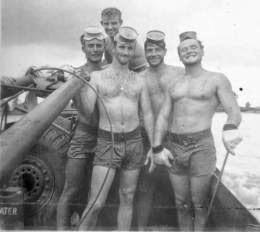
To these early pioneers and heroes of Surfing and Underwater Warfare, the Papa salutes you and is proud to present this photo grouping dedicated to the Warrior in Surf Trunks.


" We surf in freedom for those that can't ", Papa Nui 2014.